Wednesday, December 22, 2010

Practice Notes: December 22, 2010


As soon as I arrived at practice today, I saw Hejduk and McLeod out on the ice. It was just them, one net and a handful of pucks. The first ten minutes or so, they were just skating around, working on turns and stride. It was clear right away that the Duke is feeling much better while Highlander is still sore. Hejduk was pushing his skating to full throttle, not hesitating at all on turns, fully using his edges, and had a jump in his step. McLeod, on the other hand, had a limp to his stride. He would start out skating either slowly or by favoring one leg.

Then Hejduk started playing around with the puck, stick handling and ripping some wrist shots. It’s been said before, but I’ll say it again: that guy has a helluva shot. He kept wristing one up to the top right corner of the net...from just ahead of the goal line...on the right side. He did it a few times and hit the exact same spot each time. He and McLeod started doing a drill that entailed receiving a pass at the circles and shooting, then circling back to receive a pass at the blue line and shooting, then the center line and then the defensive zone circles. McLeod went at about half speed through the drill; Hejduk did it full speed.

During the time they were out there, Hejduk stopped to talk to a friend who was watching from the glass. I heard him ask Duke how he was feeling. Hejduk replied, “Great! I’m feeling great. It’s (inaudible) normal.” Now whether he said it IS back to normal or it is ALMOST back to normal, I’ve no idea. But from watching him today, my money is on him playing tomorrow.  However, I don’t see McLeod coming back until after the Christmas break.

Exit Hejduk and the Highlander. Enter Red’s brother, the Zamboni Master.

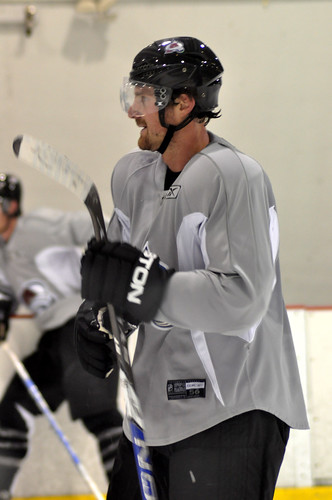
Galiardi and Dupuis hit the ice first, even before Red’s bro was done cutting the ice. I think he was a little miffed about that, too. The rest of the boys started filing in after that and were just skating around and putting some pucks on net and chatting. O’Reilly did some stick handling with a puck and then would pick it up on the blade of his stick, toss it about 15 or so feet in the air and then catch it on the blade again. It was pretty amazing to watch.

The general atmosphere was positive. I didn’t feel that heavy weight of a bad game the night before like I have at other practices. There was some joking and plenty of smiles, but it was pretty quiet otherwise. Though I don’t think they were super down on themselves for the loss last night, it was very evident they were ready to work.

The players jumped into a couple of quick drills. On one side of the ice, they were working on one-timers with Sly. On the other, they were practicing set up passes in the offensive zone with Kono. At one point, so many players hit the post on their one-timers that I thought it was part of the drill. Alas, it was not. The guys on the other end got totally schooled by Kono when one of them coughed the puck up, and the other couldn’t corral it. Three players tried to get the puck from him. Did not happen, not even close. Kono laughed very heartily about that...as did I.

At about the 20 minute mark, Sacco called the boys over to take a knee. He didn’t look angry, and no smoke was coming from his nostrils. Still, he was speaking very emphatically and with a serious undertone. You could tell he meant business for the day, but that it wasn’t going to be a beat down. Clearly, he was going to focus on what they need to fix rather than yelling at them for what they did wrong. Good call, if you ask me. One loss to a great club after a six-game winning streak isn’t anything to freak out about.

Thus, rather than a bag skate, they did their typical warm up: snake between the blue lines, first few laps forward, then backward, and then pushing the speed through the neutral zone. Everyone pretty much put in the same effort, but what I found humorous was how much more easily the defensemen transitioned from skating forward to backward than did the forwards. I have seen that in rec leagues; I guess I never expected it to happen at the pro level, too.

After the warm up, the team split up, and Sacco sent them to the four corners to prepare for their next drill. While they were doing it, I noticed that there wasn’t a lot of chatter between the players who were waiting for their turn. The whole team seemed very focused, which produced a nice energy in the building.

The drill itself was working on moving the puck out of the defensive zone and into an offensive chance. D-man 1 would pass the puck to D-man 2 who would pass it to a forward exiting the zone. Forward 1 & 2 would do a give and go down the ice and get a shot on net. Meanwhile, the same thing would be coming back the other way, so by the time the forwards got there, the D-men could defend against the oncoming offensive. I started watching the defense pairings, really to see how Holos, O’Byrne and Hunwick were doing. Something interesting was happening, though, which stole my attention. Of the pairings, the only one that stayed pretty much intact throughout the entire drill was Wilson and Shattenkirk. All of the other defenseman switched off on their pairs. Liles-Holos; Foote-O’Byrne; Hunwick-Foote; O-Byrne-Liles; Hunwick-Holos; Hunwick-O’Byrne. Are we going to see new defensive parings tomorrow night? Or is this just an indication that Sacco’s going with 7 D again, and he is going to leave Shatty and Mack Truck together while rotating the remaining guys?  Time will tell.

The guys took another knee at this point, so Sacco could describe the next drill. He was using the board and drawing up plays, it looked like. When the drill started, it pretty much confirmed that. The boys were involved in a mini-scrimmage. 5v5 in one zone inside the blue line. Objective? Get control of the puck. There was a lot of work in the corners and scrambling in front and behind the net; the offensive squad worked to keep the puck in the zone (the blueliners were actually doing a pretty good job, especially Shattenkirk - of course), but as soon as the defending squad was able to carry the puck out of the zone (shooting it out not allowed), the play was whistled dead and the team raced to the other end of the ice to switch roles. Fantastic drill and something they obviously needed to work on.

Unfortunately, I had to leave at that point. Duty called. It was great to get out there, though, and I’m feeling encouraged about tomorrow night’s game.


Quick Hits:
  • I love the sound of skates on ice, especially when the rink is silent but for that. The grinding sound of the blade on the ice when a player is working his edges is heaven.
  • I want a white practice jersey. Those things are SHARP.
  • Adam Foote really does have a terrible shot.
  • Watching Kono, Sly and Deader out there with the team...I just love it. I love the fact that they are former players of the team and guys that everyone - coaches, teammates, fans - really liked. What a solid coaching staff we have, folks.

Monday, December 20, 2010

Checking Out Greg Mauldin


28-year-old Greg Mauldin worked hard to get where he is as a professional hockey player. Despite experiencing a steady backward trend – going from playing in the NHL to the AHL to the UHL – which caused him to question his decision to pursue a career in hockey, the Holliston, MA native persevered. His fortitude paid off this season as he’s entrenched himself in the core make-up of the Colorado Avalanche, making the decision to send him back to Lake Erie unlikely.

The winger began playing hockey at 6 years old and worked his way up through the system while being considered an average player. At 21, he attended an open tryout for the Walpole Stars in Walpole, MA. The Stars are part of the Atlantic Junior Hockey League Junior A and the Metropolitan Junior Hockey League Junior B. Unfortunately, he was cut before getting a chance to suit up for them. A few months later, he attended tryouts for the Junior Bruins of the Eastern Junior Hockey League. Again, he was cut. Bill Riga, the Bruins’ assistant coach, told him that he’d never be anything more than a 5th line player. However, head coach Peter Masters saw something in Mauldin and suggested he spend the summer working out and shooting pucks in his backyard. At camp in the fall, it was clear to Masters that he did just that.

Part of the reason Mauldin improved so much was that he got a job at the local rink and spent every day on the ice. He would even sleep on egg crates in the locker room so that he could get some time in before work on days with an early shift. He was never late for his job. After working 8-10 hours, he would go back out on the ice for another hour and close up shop himself.

Because of his dedication, he made the Junior Bruins for the 1999-2000 season. Mauldin started the year on the midget team, but after three weeks, he played in a tournament for the Junior Bruins and netted the OT winner to help secure the championship title for his team. Another three weeks went by and he made it to the team full-time. By the end of the year, he was named MVP, finishing with 87 points (45g/47a).

That summer, after making a splash at the HNIB All-Scholastic tournament, UMass offered him a full scholarship on the first day he was eligible to sign. That was the only college who showed interest. He immediately proved to the university’s coaches that they chose wisely as he was dubbed Superman by his Junior Bruins’ teammates and coaches for always coming through in clutch moments, helping the team make it to the finals once again.

The thing that truly showed his character, though, was that he faced an unspeakable obstacle that season. After a long struggle with cancer, his father passed away midway through the season. In the face of tragedy, Mauldin still amassed a staggering 106 points by scoring 48 goals and tallying 58 assists.

Mauldin didn’t disappoint at the University of Massachusetts. As a freshman, he put up a solid 24 point season, yet in his sophomore year, he nearly doubled that total. His third year at UMass (2003-2004), he was sidelined with injuries for part of the season. However, he still managed to score at a point-per-game pace.

That would be his last year in school as he signed a contract with the Columbus Blue Jackets and played 6 games with them at the end of the 2003-2004 season, as well as 3 – including one playoff game – with Columbus’ minor league affiliate, the Syracuse Crunch. The following year (2004-2005) he registered 27 points with the Crush. After 56 games and 29 points in the 2005-2006 season, he was traded to the Minnesota Wild, where he played 11 games for the Houston Aeros.

Mauldin was not re-signed to the Wild during the off-season and, facing the reality that the UHL was his only option, considered letting go of his NHL dreams and joining the Army. "I spent all summer training (to play)… It was tough to swallow, to go from the top all the way to the bottom."  But rather than giving up, he chose to work even harder. "I quit thinking about my career going backwards… (What happened) humbled me…and reminded me of how hard I used to work and what got me to the NHL in the first place." So he signed on with the Bloomington Prairie Thunder of the UHL. He only played 2 games, though, before heading to Sweden.

In 2007, the forward attended the St. Louis Blues prospect development camp and then signed with the AHL’s Binghamton Senators, a minor league affiliate of the Ottawa Senators. He played two seasons in Binghamton, scoring 33 and 27 points respectively, and had signed a one-year contract with Ottawa for the second season.

Once again a free agent in the summer of 2009, Mauldin was offered another one-year contract, this time with the New York Islanders. He spent all but one game that season with their minor league team, the Bridgeport Sound Tigers, where he netted 25 goals and helped out on 29 more. That off-season, he was contacted by the Colorado Avalanche and, after talking with them, decided he liked what the Avs had to offer. Thus, he signed yet another one-year contract for the 2010-2011 season.

Despite making a strong showing in training camp, the winger was assigned to the Lake Erie Monsters at the start of the season. Still, his skill and work ethic did not go unnoticed; he was given the captaincy for the team after David Liffiton and David Van der Gulik were recalled by Colorado. Certainly his point production of 5 goals and 7 assists in 14 games was a strong example for his teammates.

Because of injuries on the Avalanche, Mauldin got another chance at the NHL. In his very first game, he made it count by scoring a short-handed goal off a nice feed from David Jones.  "I couldn’t have asked for a better goal to suit the kind of style I play," said Mauldin. "To beat the defenseman in a foot race, to beat the goalie high…the emotions of it were unbelievable."

Since then, the hard-working forward has hit the back of the net 5 more times, recorded 5 assists and is a +10. Coach Sacco has relied on him in key moments, including the penalty kill and waning seconds of games. Of Mauldin, Sacco said, "When you think of Mauldy, you think of perseverance. He stuck it out through some tough times, and when you do that, sometimes things happen for the right reasons.

"He’s one of those guys you can just rely on. He’s dependable. I know what I’m going to get from him night in and night out." His teammates are impressed with him, too. "He’s relentless on the puck," said Daniel Winnik, "never gives up, and is just a great team player."

Mauldin’s hard work and resolve have given him the opportunity of which he’s always dreamed. He’s put in effort that many never would and overcome obstacles that would cause most people to quit. As expected, he’s not taking it for granted. "If I don’t play well tomorrow, they would have no problem sending me down and calling someone else up. It’s a league of ‘what have you done for me lately?’ I figure if I’m playing well and those guys (out for injuries) do come back, maybe they’ll still keep me."

He’s not giving them much of a choice; with his play, work ethic and attitude, Greg Mauldin is exactly the kind of player any NHL team would love to have.


References:

Author's Note: Apologies for any mistakes. It was a bit difficult to see the computer monitor through the tears. =)


Saturday, December 18, 2010

The Breakaway has a new writer!

Let's welcome Stazz to the crew. I'm sure we're all looking forward to his insight and wit!

Friday, December 17, 2010

What's in a name?

Hockey players are famous for shortening their teammates’ names; this generally means finding a one-syllable version of either their first or last name and adding “s,” “er” or “ie” to the end. This has yielded nicknames like Ports, Footer, and Paulie. For some players, this turns into an unfortunate scenario; I imagine Kyle Cumiskey is wishing he was born to the Spead family.

Fans and media folk aren’t any different with the teams. More than any other sport, it seems, hockey people feel it necessary to truncate NHL team names, usually to one syllable: Caps, Yotes, Hawks, Nucks, Oil, Preds, Sens. One team is even bestowed with a one-syllable nickname from another nickname; a person can get quite confused when watching a Canadiens/Bruins game and hear the announcers talk about how well the Habs are playing. However, just like players, some teams – especially those with names that can’t easily be reduced to one syllable – get labeled with a regrettable abbreviation. How’s the season going for ya, BJs?

The Avalanche is no different. People across the hockey world have pretty much come to a consensus that this team is called the Avs. Unlike other teams, though, there is some contention. For example, there are those fans who call them the Aves. I look at that and think, “Who are the Avenues?” It is also troublesome because basic phonetics tells us that the “e” on the end makes the “a” say its name, which means they are the Ayyyyvs. Perhaps that would work if the Fonze was an Avalanche fan, but for anyone else, it just doesn’t fly.

Another common misstep with the Avs is to call them the Lanche. What is a “lanche” – something a guy with a lisp uses in a joust? Worse, it makes me picture a whining, crying six-year-old girl. I don’t know about you, but I don’t want my team associated with a spoiled brat who wants her golden goose and wants it now. No, I’d prefer it to be a Stanley Cup that the team wants; the wanting it now part is good, though.

What does AVS stand for? I really want to know because it seems it has something to do with the Avs, but I can’t quite figure out what. Is it Altitude Visitor’s Sickness, something away teams experience here a mile high? Or maybe it’s Assume Victory Stance. That’s kind of cool, except what if they lose? Does it morph into Almost Victorious, Sorry?

I guess, in the end, it doesn’t really matter. After all, we know who they mean. Besides, it could be worse: people could call them the Wings.

Wednesday, December 15, 2010

Checking Out Kevin Porter

(Originally posted on Mile High Hockey on December 14, 2010.)


With all the injuries the Avs forward corps has sustained, Coach Sacco has trusted Kevin Porter with top line duties, giving him the opportunity to flank high-scoring center Paul Stastny. Mr. Clutch, as some call Porter, has scored 3 game-winning goals already this season - tied for 11th in the league with players like Sidney Crosby and Alex Ovechkin. This certainly makes him a reasonable choice for the job.

Prior to losing players like Chris Stewart, however, Porter played most of his minutes on the third and fourth lines. What makes Sacco think he can handle the pressure of the first line? Perhaps it’s because of a solid top-line history.

24-year-old Kevin Porter, a natural center, was taken by the Phoenix Coyotes in the 4th round of the 2004 draft. He first gained national attention for his hockey skills during the 2002-2003 season when he appeared in the National Team Development Program Under-17s and finished 2nd in scoring (20g/11a). The following year, he captained the NTDP-U18 team which won the silver medal in the World Under-18 IIHF championships. He recorded 8 goals and 29 assists during the regular season.

In 2004, Porter began his career at the University of Michigan. As a freshman, he put up 24 points (11g/13a) in 29 games and was named to the 2005 World Junior Championship team for the United States. He had 5 points in 7 games. The 2005-2006 season would see his production with the Wolverines increase to a point-per-game pace. That year, he finished 3rd in team scoring, tied for 1st in goals scored (17), 2nd in power play goals (7) and led the team in game-winning goals (4). Once again, he was selected captain and led Team USA to fourth place at the WJC, maintaining nearly a point-per-game pace. His teammates voted him their best forward.

Porter continued to improve in goal-scoring by posting 24 goals and 34 assists in his junior year at U of M. He received Player of the Month honors and skated for both the CCHA Second All-Star team and the CCHA All-Tournament team. Yet it was in his senior year (2007-2008) with the Wolverines that he truly dominated. As captain of the team, he amassed 63 points (33g/30a) in only 43 games, ending the year second in scoring to Nathan Gerbe of the NCAA. While setting a scoring record (4 goals) in the East Regional Semi-Finals, he helped his team reach the Frozen Four in Denver. During the tournament, he was responsible for 5 of Michigan’s 7 goals and assisted on a 6th.

The 2008 year ended with Porter tying for 2nd in the nation with 15 power play goals.  He also had 18 multiple-point games and a +33.  He received the CCHA Player of the Year award, was a finalist for the league’s Best Defensive Forward award, named to the CCHA First and the NCAA West First All-Star teams, and named the Hockey Commissioners Player of the Month in January. He also was given honors as the University of Michigan’s Male Sportsperson of the Year. Over his collegiate career, Porter was the nation’s active scoring leader, scoring a total of 183 points. In addition to all his on-ice contributions, Porter volunteered for the Make-A-Wish foundation and spent time visiting patients at Mott Children’s Hospital.

The culmination of his years with the Wolverines, however, came when he was awarded the Hobey Baker as the top collegiate hockey player in the NCAA. Said his teammate Chad Kolarik, "He cares about the team first. He's upset that we didn't get to win a national championship. But when you're a Hobey Baker finalist, that's pretty special. He's done all these things to help us grow as a team and help us stay at the top of the nation as the No. 1 seed. It was his year, it was his team..."

After signing an entry-level contract with the Phoenix Coyotes in 2008, Porter spent the last part of the season with their AHL affiliate, the San Antonio Rampage. He then made the Coyotes roster for the 2008-2009 season straight out of training camp. He tallied an assist in his very first NHL game. Porter played in Phoenix through the end of the year - having played 34 games and scoring 5 goals and 5 assists - before finishing the season with the Rampage (13g/25a).

He started out the 2009-2010 season in San Antonio where he played 52 games and put up 25 goals and 15 assists. He had a few call-ups to Phoenix during that time, but only took the ice for four games, during which time he was kept off the scoreboard.  On March 3, 2010, Porter was traded to the Avalanche in a deal that included Peter Mueller and sent Wojtek Wolski to the Coyotes. The forward - now playing left wing - finished the season with the Avs’ organization, playing 16 games in Denver - scoring 2 goals and chipping in with an assist - and 4 games in Lake Erie (1g/0a).

The 2010-2011 season saw Porter making the Avs’ team from camp. Yet, after going pointless in 6 games, he was back in the AHL again, this time with the Lake Erie Monsters. He never got to play a game, though, before being recalled to Denver where he has remained for the season so far. He’s made the most of his 25 games with 5 goals, 3 assists and a +9. His ability to come up big in critical moments and his sincere work ethic have kept him with the Avalanche. As injured players return, however, his spot on the roster will be in question. Looking at his strong history of making the most out of his opportunities, it's a safe bet he will do whatever it takes to stay in Denver.

References:
http://en.wikipedia.org/wiki/Kevin_Porter_(ice_hockey)
http://avalanche.nhl.com/club/player.htm?id=8471331
http://bleacherreport.com/articles/522970-kevin-porter-is-doing-everything-he-can-to-stay-with-the-avalanche
http://www.hockeysfuture.com/prospect/kevin_porter

Checking out Tomáš Fleischmann

(Originally posted on Mile High Hockey on November 30, 2010.)


Another day, another trade. Our third installment of Checking Out features the Avs’ new forward, Tomáš Fleischmann.

26-year-old Fleischmann, born in Koprivnice of the Czech Republic, started his career in Europe, playing for the Czech-3 league in the 2001-2002 season. He spent time playing for both Vitkovice Jr. and Novy Jicin. With Vitkovice Jr., he amassed 51 points (26g-35a) in 46 games. That summer, he was drafted by the Detroit Red Wings. The following season, he made his first North American appearance with the Moose Jaw Warriors where he played 65 games and scored an impressive 21 goals while assisting on 50 others. This put him second on the team in points and the top scoring rookie in the WHL. The Warriors made it into the playoffs, and Fleischmann contributed with four goals and 11 assists, leading the team in points in the 12 post-season games they played. After finishing the year in Moose Jaw, the forward represented his country in the World Junior Championships. This would be the first of two consecutive years in which he did.

He returned to Moose Jaw for the 2003-2004 season, making an impressive showing with 75 points, 33 of them coming off of goals. Fleischmann ended up ranked second on the team in points, goals and assists, as well as tied for first with 10 power play goals during the regular season. He also had two short-handed goals that season. During the playoffs, he logged 3 goals, 4 assists and a striking three short-handers.

In 2004, he was traded to the Capitals and spent the year playing in Portland. However, his season was cut to only 53 games due to an injury. He ended the year with only 19 points (7g-12a). Fleischmann made his NHL debut on November 13, 2005. In the 14 games he played with the Capitals, he recorded 2 assists. Although his time with the Caps wasn’t overwhelming, he continued to light it up in the lower-leagues. He was, once again, a powerful force on his team. In Hershey, he scored 30 goals and 33 assists, was the team leader in game-winning goals (6) and second in power-play goals (13) and was second on the team in plus/minus (+14). During the regular season, he had a nine-game point streak and 3 three-point games. He dominated in the playoffs, as well, topping the team with 32 points (11 of which were goals). His 21 assists not only led his team, but was the best of all AHL players. His playoff run included 3 games with 3 or more points, including a 4-point game and a 3-pointer in the final round.

Clearly, Fleischmann’s confidence was high, as was the Caps’ confidence in him. He appeared in 29 games with the big club in 2006-2007, putting up 8 points during that time, most of which came in the last 21 games of the season. He ended the season as one of two Washington players to have a 4-point game (2g-2a). In his 45 games in Hershey,  he was more than a point-per-game player (totaled 51 points). Again he scored 3 short-handed goals. He continued his stellar play in the playoffs, registering 21 points (5g-16a) in only 19 games, leading the AHL in post-season assists for a second straight year. In Game 5 of the Eastern Conference Semifinals, he set a club record for 5 points in one game (1g-4a).

His hard work and high-scoring efforts landed him a solid spot on the Caps’ roster in the 2007-2008. He appeared in 75 games for Washington and scored 10 goals and 20 assists, placing him 9th on the team in scoring.  The following season, he spent another 73 games at the NHL level. He put up impressive numbers in 2008-2009: 19 goals, 18 assists, a 14.5 shooting percentage, 4 game-winning goals, 7 goals on the power play; he averaged 15:04 TOI, had 8 multi-point games, maintained 6 streaks of three games or more where he scored at least one point.  Fleischmann played in all 14 games during the Stanley Cup playoffs that season, scoring three goals (one of which was a game-winner) and 1 assist.

Last season—which was hampered by a blood clot which kept him out of the line up for 11 games to start the season—he posted NHL career-high 23 goals and 28 assists for 51 points in only 69 games played. He also recorded one assist during the Caps’ six-game post-season run. This season, after being signed to a one-year, $2.6 million deal, he’s put up 10 points (4g-6a) in 23 games, is a +3 and has a shooting percentage of 9.1.

Fleischmann has been the subject of trade rumors since the summer, but Bruce Boudreau, the Caps’ head coach, insisted it wouldn’t happen. The rumors surrounded the return of Eric Belanger, making a trade involving Fleischmann seem plausible. Perhaps it was just timing which made Boudreau so adamant over the summer.

Evaluation of his play indicates that he’s not really suited for the center position he’s been manning with the Caps. His face off percentage is dismal (43.1%). Yet, he is considered a strong play-maker and sniper, so the doubts may be unfounded.  Brook Laich commented as such, saying that "results speak for themselves." Washington won 14 straight games with Fleischmann at center. There is much concern, though, about repeated injuries, as he has missed games due to physical ailments every year he has played professional hockey. He is said to be a bit weak in the corners and unwilling or unable to play a hard, physical game. His coaches were never concerned about that, though, as he is said to be intelligent and positionally sound in his own end. His ability with the all-important outlet passes has given him plenty of time on the penalty kill. In addition, he seems dedicated to doing well. Of the questions surrounding his inconsistent performance and questionable spot on the team, Fleischmann said, "I’m just going to do my job the best I can. What can I say if I’m the best choice? I’ve told people I want to be the No. 1 center. I want to be as good as [Backstrom] – that’s my goal. That’s how I want to play. I just want to be good for the team and if I’m the No. 2 center then do my job right."

One of his biggest assets, it appears, is his character. He’s well-liked and a positive influence in the locker room. Given the right linemates, the outlook points to high production and smart, creative play.

Checking Out Matt Hunwick

(Originally posted on Mile High Hockey on November 29, 2010).


Given the recent trade of Colby Cohen to Boston for defenseman Matt Hunwick, I decided to give you a double-dose of Checking Out this week. It’s time we learn a little more about the newest Av.


25-year-old Hunwick is a Warren, MI native, drafted in 2004 by the Boston Bruins in the 7th round (224th overall). He attended the University of Michigan where he was named captain in his senior year. During his time with the Wolverines, he posted 24 goals and 73 assists. He was named to the CCHA All-Rookie team in his freshman year and the CCHA Second Team All-Star rosters as a sophomore and junior. As a senior, he played on the All-American West Second-Team and the CCHA First Team All-Stars.  He was also given the award for the CCHA’s top defensive defenseman.  In 2004 and 2005, he competed with Team USA in the World Junior Championships, posting no points in his first appearance and a 0-4-4 record in his second.

Matt Hunwik spent his first year as a professional hockey player in Boston’s AHL affiliate, the Providence Bruins. He recorded 23 points in 55 games. During that year, he was recalled by Boston 13 times during which time he put up one assist and logged 40 PIMs. Providence made it into the playoffs that year with Hunwick scoring 5 assists in 10 games.


The 2008-2009 season was his first real foray into the NHL. He played 53 games, scored 6 goals, and got 21 assists. His 27 points and +15 rating was his best to date. During that time, he had 6 multi-point games, as well as a six-game point streak (tying Ray Bourque for a club record as a rookie defenseman). He also played 6 games at forward where he had one goal and one assist. Hunwick didn’t get to participate in the Bruins’ post-season but for one game, during which he sustained a spleen injury. On April 18, 2009, he had an emergency splenectomy and missed the rest of the playoffs. In 2009-2010, he struggled both offensively and defensively, being a healthy scratch frequently, putting up only 14 points and registering -16 in 76 games. However, in his 13 games in the playoffs, he ranked third on the team in assists at 6. This season did not start off well for the young defenseman. His -3 was the worst of the team in the Bruins’ 5-2 loss to Phoenix in the season opener in Prauge.  About his dismal start, Hunwick said, "It’s a terrible feeling. I know my first feeling was ‘shit, this is going to be last year all over again.’ I just couldn’t get any breaks to go my way. But the next night, I was plus-2. I wasn’t even directly involved in those plays. That’s just how it works. You get noticed for being a plus and you get noticed for being a minus. You don’t necessarily have to do anything on any of the goals to get the recognition. Sometimes the bounces go your way, but it was nice to get back to an even playing field over the next few games." So far this season, he’s played 22 games, scored 1 goal and 2 assists with a +4.


Hunwick, despite his college honors, is considered to be an offensive-defenseman with his ability to skate and jump in on the offense as his biggest asset. He has spent time on the point during power plays--paired with Zedna Chara--and has found some success there. However, he spends little time on the ice when the team is short-handed.


The former-Bruin seems to be regaining some of his early on-ice production, and hopefully a change in scenery--and a young, fast team--will propel him to the next level offensively. He also might give some added toughness, despite being only 5’11" and 193 lbs. He recently threw down the gloves against Evander Kane, something not many players are willing to do:


References:

http://fantasybaseball.usatoday.com/content/player.asp?sport=nhl&id=2435
http://www.thebruinsblog.net/category/boston-bruins/matt-hunwick/%5C
http://en.wikipedia.org/wiki/Matt_Hunwick
http://bruins.nhl.com/club/player.htm?id=8471436&view=bio